

Basement complaint
A lower-level storage room smells stale after weekends, cardboard softens in summer, and the owner is ready to talk about wall openings. Before that scope grows, the contractor needs a simpler diagnosis.
The problem may be low air exchange, high humidity, poor discharge routing, or a moisture source that a fan cannot solve. Poor basement ventilation can often be reviewed first as airflow plus moisture control: estimate CFM, identify a discharge path, check humidity, then decide whether an inline fan, exhaust fan, dehumidifier, or combined approach belongs in the RFQ.
Separate stale air from dampness
Poor basement ventilation is rarely a single-number problem. The complaint may be stale air, musty odor, seasonal dampness, heat from stored equipment, or a room that never feels dry even after cleaning. Those conditions can share the same space while still leading to different equipment paths.
That is why many basement searches start with a renovation question when the real need is operational. Before cutting new openings or rebuilding the room, it is worth separating air movement, moisture control, and source conditions. A basement with low air exchange may need a ventilation path. A basement with persistent dampness may need dehumidification first. Some rooms need both.
For distributor and contractor review, the useful first step is not to guess a final fan. It is to define what the space is failing to do now: remove odor, dry the room after humid periods, move air out of a closed storage area, or support utility equipment that adds heat and moisture.
Separate source control from air movement. A fan can move stale air, but it will not stop water entry, fix a leaking wall, or make a blocked drain path acceptable. A dehumidifier can remove moisture, but it will not create a controlled exhaust route when the room needs contaminant or odor removal.
For room-volume airflow planning, start with the ventilation CFM calculator. For basement-specific symptoms, review the basements and storage application page.
Duct Fan Exhaust Path
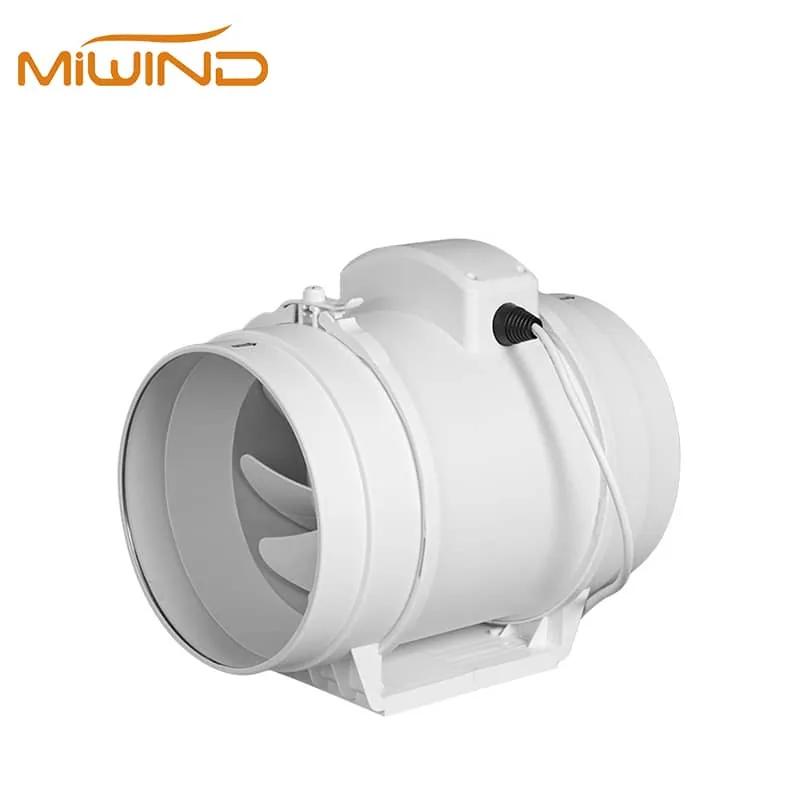
If the space is mostly dry but feels stale, trapped, or odor-heavy, the first review may center on airflow rather than moisture removal. A duct fan or exhaust fan path can help when the room needs air exchange and a practical discharge route already exists or can be added without rebuilding the whole space.
This approach is especially useful in storage basements, utility rooms, and light-use lower levels where the main problem is lack of circulation. In those cases, an early CFM review, duct path check, and termination check can do more than a broad renovation concept.
The key is to keep the airflow discussion realistic. If the room has severe moisture entry through walls or repeated water intrusion, a ventilation fan alone will not solve the root condition. It may improve the air feel while leaving the dampness issue unresolved.
A fan selection should include target CFM, duct size, equivalent duct length, elbow count, grille or louver restriction, backdraft damper, termination location, sound sensitivity, and service access. Basement projects often fail when the fan is chosen by duct diameter alone.
| Observed condition | Likely first direction | Why it matters |
|---|---|---|
| Stale or trapped air | Ventilation CFM and exhaust route | Air exchange may be the main missing function. |
| Musty odor with mild dampness | Ventilation plus moisture check | Odor and moisture may need two coordinated responses. |
| Dry room but hot equipment corner | Targeted airflow support | The issue may be heat buildup rather than humidity alone. |
| Persistent dampness on surfaces | Dehumidification and moisture source check | Moisture load may exceed what airflow alone can correct. |
dehumidification belongs in the same conversation
A basement often feels under-ventilated because it is also humid. When moisture is high, the room can feel stale even if some air movement is present. That is why basement reviews should ask for current humidity, seasonal pattern, and whether the complaint gets worse after rain, in summer, or after the room stays closed.
If the buyer is dealing with visible dampness, stored goods sensitivity, or a room that never dries properly, dehumidification should move into the same review. In that case, the right question is not only how to move more air, but how to remove enough moisture without creating a noisy or impractical installation.
This is where a simple combination strategy becomes valuable. A dehumidifier can handle the moisture burden while a ducted airflow path reduces stagnation and odor. That kind of modest coordinated fix often solves more than a large renovation idea that was never clearly matched to the room problem.
Use pints/day as a review input, not a standalone answer. Current relative humidity, target humidity, temperature, drainage, usage pattern, and moisture source decide whether a compact unit, commercial dehumidifier, or ventilation-plus-dehumidification package should be reviewed.

For moisture-control inputs, use the dehumidifier sizing calculator. For capacity context, reference the dehumidifier size chart.
to measure
Before choosing equipment, collect the room area, ceiling height, approximate humidity level if available, whether odor or dampness is the bigger complaint, and whether a duct route or discharge path already exists. Note if the space stores boxed goods, tools, electrical equipment, or other materials that change how airflow should be treated.
If the basement has only one practical wall or ceiling route for ventilation, that should be documented early. Service access matters too. A fan that fits on paper but is impossible to reach for cleaning or replacement will not age well in a lower-level utility environment.
One or two photos of the room and duct path usually help more than a long written description. They show whether the space is open storage, divided rooms, mechanical-use only, or a mixed basement condition that may need both odor and moisture attention.
If the basement is occupied or used for storage that is sensitive to odor or humidity, document the operating schedule. A room used only for storage can often tolerate a different sound and control profile than a finished lower level or staff-access area.
- Capture area and ceiling height for an initial airflow estimate.
- Note whether the problem is odor, dampness, heat, or a combination.
- Check whether a discharge path already exists or can be added simply.
- If humidity is high, record a current reading and when the issue is worst.
- Record duct length, elbow count, termination, controls, and service access before selecting a fan.
A practical path
Many basement spaces can often be addressed without structural rework if the review stays disciplined. Start with the room complaint, estimate an initial airflow target, identify whether moisture removal belongs in the same package, and then review whether inline fans, exhaust fans, or dehumidifiers fit the existing space and service conditions.
That sequence does not promise that every basement can be solved without construction. It does, however, prevent the common mistake of jumping straight into renovation language before the room has been translated into airflow, humidity, and operating conditions.
Escalate beyond equipment-only review when there is active water entry, mold remediation concern, combustion-air impact, code-driven occupancy change, or no safe discharge route. Those conditions should be handled by the appropriate project professional before a simple product recommendation is treated as sufficient.
Use basement airflow and moisture articles as early guidance. Final product direction depends on the room condition, discharge path, and model-level installation limits.
For duct fan details, open the duct fan selection guide. For fan family options, compare MiWind inline duct fans.
to send for a basement airflow review
A useful basement inquiry should include room dimensions, whether the complaint is odor or dampness or both, whether a discharge path already exists, and whether the space needs quiet operation or easier service access. Add photos if the room is divided or crowded with equipment.
That information is usually enough to move the discussion from an unclear ventilation complaint into a practical review of fans, moisture-control support, and the simplest next step for the room.
Calculate a planning airflow target with the ventilation CFM calculator. When room photos and duct notes are ready, request a basement airflow and moisture review.