
Commercial Dehumidifier Sizing
The dehumidifier runs for most of the day, but towels still dry slowly and condensation keeps returning near a cold-adjacent door. The owner asks for a larger unit because the room feels like it never catches up.
That may be undersizing, but it may also be a changed room load, blocked airflow clearance, poor drainage, more door cycles, or a colder operating condition. Check current RH, target RH, pints/day capacity, room temperature, airflow path, drainage, occupancy, and recovery time before replacing the equipment.
Undersized usually shows up in room behavior first
A commercial dehumidifier is rarely judged only by its label capacity. Buyers start to suspect undersizing when the room still feels damp, humidity readings drift back quickly, condensation returns after door openings, or the unit seems to run constantly without bringing the space back under control.
Those are useful warning signs because they point to a mismatch between the room's real moisture load and the equipment path that was installed. The issue is not always that the unit is defective. In many cases, the load changed, the room was never sized carefully, or the moisture source was treated too simply at the start.
For troubleshooting, this is the important distinction: an undersized dehumidifier is not just a small machine. It is a machine that cannot recover the room condition under the way the space is actually being used.
A useful review compares the room's current behavior with the original sizing assumptions. If occupancy increased, doors open more often, product is stored differently, ventilation changed, or drainage became unreliable, the installed unit may now be facing a different moisture load than the one it was selected for.
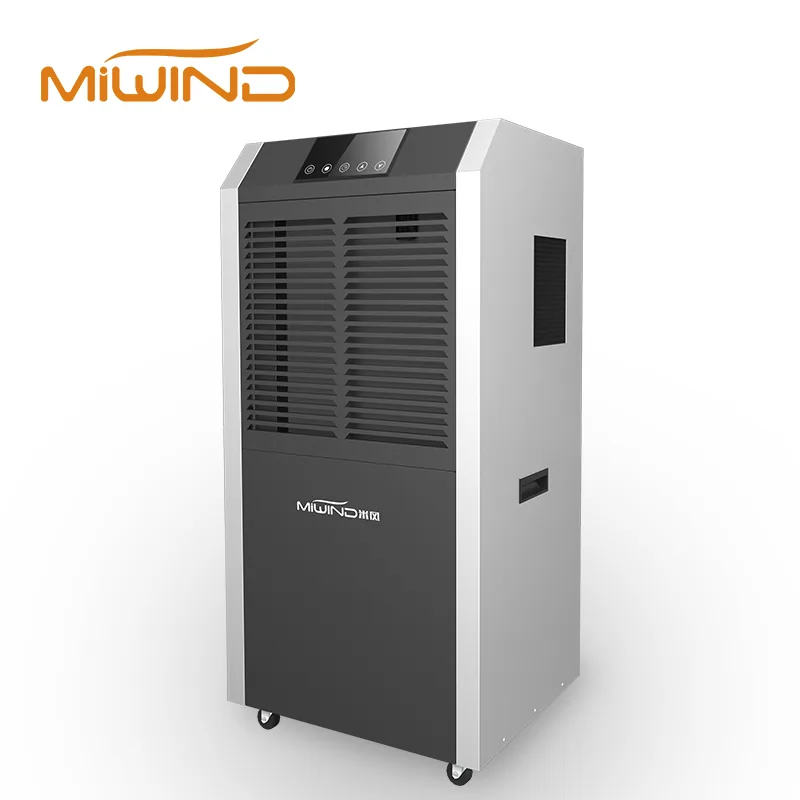
For capacity and room-load context, start with the dehumidifier sizing calculator. For equipment range context, compare MiWind dehumidifier products.
Common signs that capacity is not keeping up
The clearest sign is sustained humidity above the target even when the unit runs for long periods. A room that only improves slightly, then drifts back toward dampness, often indicates that the moisture load remains larger than the unit can remove during normal operation.
Another common sign is recovery failure after operating events. If a storage room, gym, or cold-adjacent space becomes wet or humid after occupancy peaks, deliveries, or door cycles and then takes too long to recover, the dehumidification path may not be sized for the real operating pattern.
Look at time, not just a single reading. A room that reaches target RH overnight but loses control during working hours may need a duty-cycle or airflow review. A room that never approaches target RH may need a capacity, drainage, or source-control review before any replacement is quoted.
| Observed sign | What it may indicate | Review focus |
|---|---|---|
| Humidity stays above target | Capacity may be below the real room load. | Room conditions and moisture source |
| Unit runs for long periods | The machine may be working continuously without catching up. | Duty cycle and sizing inputs |
| Condensation returns quickly | Moisture spikes may exceed recovery capacity. | Door use, infiltration, and temperature |
| Only partial improvement in summer or peak use | The load may be seasonal or event-driven. | Operating pattern and room use |
| Water removal drops unexpectedly | Drainage, temperature, airflow, or coil condition may be involved. | Installation and service conditions |
the problem is not the dehumidifier alone
An apparently undersized unit may actually be facing a room problem that was never brought into the equipment selection. Outdoor-air entry, repeated door openings, poor drainage, process moisture, or stale air zones can all make a dehumidifier look small even when the nameplate capacity seemed reasonable at first.
This is especially true in gyms, storage rooms, and cold-adjacent spaces. A room with repeated humid-air entry or uneven circulation may need better airflow support in addition to more dehumidification. If the space has odor, stagnant corners, or poor recovery after occupancy, the moisture discussion should not stay isolated from the ventilation discussion.
That is why troubleshooting should not start with a replacement model alone. It should start by asking whether the room use, moisture source, and operating pattern still match the original selection assumptions.
Installation details matter too. Blocked intake clearance, poor discharge airflow, a kinked drain hose, short cycling, incorrect placement, or a sensor exposed to a non-representative air pocket can all make a reasonable dehumidifier perform like an undersized one.
For capacity context, review the dehumidifier size chart. For fitness spaces with uneven damp zones, compare the gym moisture problem and air distribution guide. When stale air or uneven circulation is part of the complaint, estimate airflow with the ventilation CFM calculator.
How operating pattern exposes undersizing
Many commercial moisture issues are not steady-state problems. They appear after doors open, after people enter the space, after product is moved in, or during a humid season. A unit that looks acceptable during light use may become clearly undersized once the room returns to its real operating schedule.
That means the buyer should review the room by event pattern, not only by area. Ask when humidity becomes noticeable, whether the problem appears at the same time every day or season, and whether the space recovers overnight or remains damp into the next cycle. Those notes often reveal the difference between a marginally small unit and a room that needs a broader moisture-control approach.
For gym, storage, and cold-room-adjacent spaces, document the trigger. Occupancy, wet materials, open doors, warm product movement, outdoor-air makeup, or cleaning schedules can create moisture spikes that a square-foot sizing estimate never captured.
- Note when humidity climbs fastest: after occupancy, deliveries, or weather changes.
- Check whether the room ever reaches the target condition and holds it.
- Record whether the space recovers slowly or never fully recovers at all.
- Compare peak-use readings with overnight readings so recovery time is visible.
- Note whether airflow around the unit is blocked by shelving, walls, or stored goods.
For fitness spaces, compare the moisture drivers on the gyms and fitness centers application page. For cold-adjacent openings, review the cold-room door application guide.
to review
Before jumping to a larger model, collect the room area, ceiling height, current and target humidity, temperature range, moisture source, drainage condition, and operating schedule. Confirm whether the room use changed after the original installation and whether ventilation or door-use conditions are now more demanding.
If the dehumidifier sits in a room with poor air movement, limited intake clearance, or an awkward drain path, those installation conditions should also be reviewed. A correctly sized unit can still behave poorly when the room does not allow it to work as intended.
A stronger recommendation usually comes from pairing room behavior with those inputs. That is what turns an imprecise concern about undersizing into a useful decision about more capacity, better airflow support, or a combined solution.
A room that stays damp does not automatically prove the existing dehumidifier is wrong by nameplate alone. Review room load, operating pattern, and installation conditions together.
For storage and basement symptoms, use the basements and storage application page.
to send for an undersizing review
Send the room dimensions, current humidity, target humidity if known, temperature range, when the problem gets worse, and whether the room also has stale air or door-cycle moisture spikes. Add the current dehumidifier information and one or two room photos if possible.
Also include the current model, approximate run time, drainage arrangement, where the unit sits in the room, whether shelves or walls block airflow, and whether the room has changed since the equipment was installed.
That gives the reviewer enough context to judge whether the room needs more dehumidification capacity, better airflow support, a placement correction, or a broader moisture-control approach.
Organize the room and moisture inputs in the dehumidifier sizing calculator. When readings, photos, and current equipment notes are ready, request an undersized dehumidifier review.