

Stale training room clue
The new training room heats and cools properly, yet it feels stale by mid-morning when attendance is high. The owner asks for an ERV system, but the real question is whether the room needs more outdoor air, better filtration, duct balancing, recovery equipment, or some mix of those items.
Start the review by separating the symptom from the equipment request: who uses the room, when it fills up, what fresh-air target is known, and whether recovery equipment is solving comfort, humidity, filtration, or energy concerns.
Fresh air need comes
An office building does not need an ERV just because it has occupants. The first question is fresh-air need: room use, expected occupancy, schedule, existing HVAC capacity, humidity goal, filtration expectation, and whether the project is trying to recover energy from exhaust air.
Office space ventilation fans can move air, but stale occupied rooms often need outdoor-air CFM, filtration, recovery, duct routing, and controls reviewed together.
ERV and HRV discussions should stay separate from final ventilation design. This article supports early equipment selection, but final outdoor-air requirements, code compliance, and ventilation strategy should be confirmed by the project engineer or authority having jurisdiction.
That starting point keeps the review grounded in building use rather than product preference. A lightly occupied office, a training room with daily peaks, and a classroom block with fluctuating schedules can look similar on a plan while needing different ventilation decisions.
The buyer's note should read more like a fresh-air brief than a unit-size request: occupancy, area, ceiling height, target CFM or ACH basis, duct route, filtration level, control expectation, service access, and whether recovery is part of the energy or humidity strategy.

For early airflow planning, estimate the room with the ventilation CFM calculator. For office-specific context, review the offices and classrooms application page.
Signs that ERV review belongs in the project
ERV review becomes more relevant when a building needs controlled outdoor air while also managing energy and humidity transfer. Offices, classrooms, training rooms, and fitness spaces can all reach that point depending on occupancy and schedule.
Many retrofit discussions start because occupants describe stale rooms, uneven comfort, or spaces that feel overloaded once the building fills up. Those complaints do not automatically point to ERV equipment, but they do signal that the fresh-air path deserves a structured review instead of an ad hoc fan-only response.
The more variable the occupancy is, the more important that structured review becomes. Rooms that swing from lightly used to fully occupied in short periods often expose the limits of improvised ventilation approaches. That does not prove an ERV is required, but it does justify a clearer equipment conversation.
ERV review also belongs earlier when the project needs a defined supply and exhaust path, filter service access, drain or condensate planning, freeze or climate considerations, and control coordination with the existing HVAC system.
- Rooms feel stale during occupied periods.
- Outdoor-air needs are being added to an existing building.
- Humidity control matters during ventilation.
- Filter access and service access can be planned early.
- The project wants a defined fresh-air path rather than ad hoc exhaust only.
For recovery-equipment questions, organize the project in the ERV/HRV selection worksheet. For airflow benchmarks, keep the ventilation CFM chart.
ERV, HRV, and supporting fans
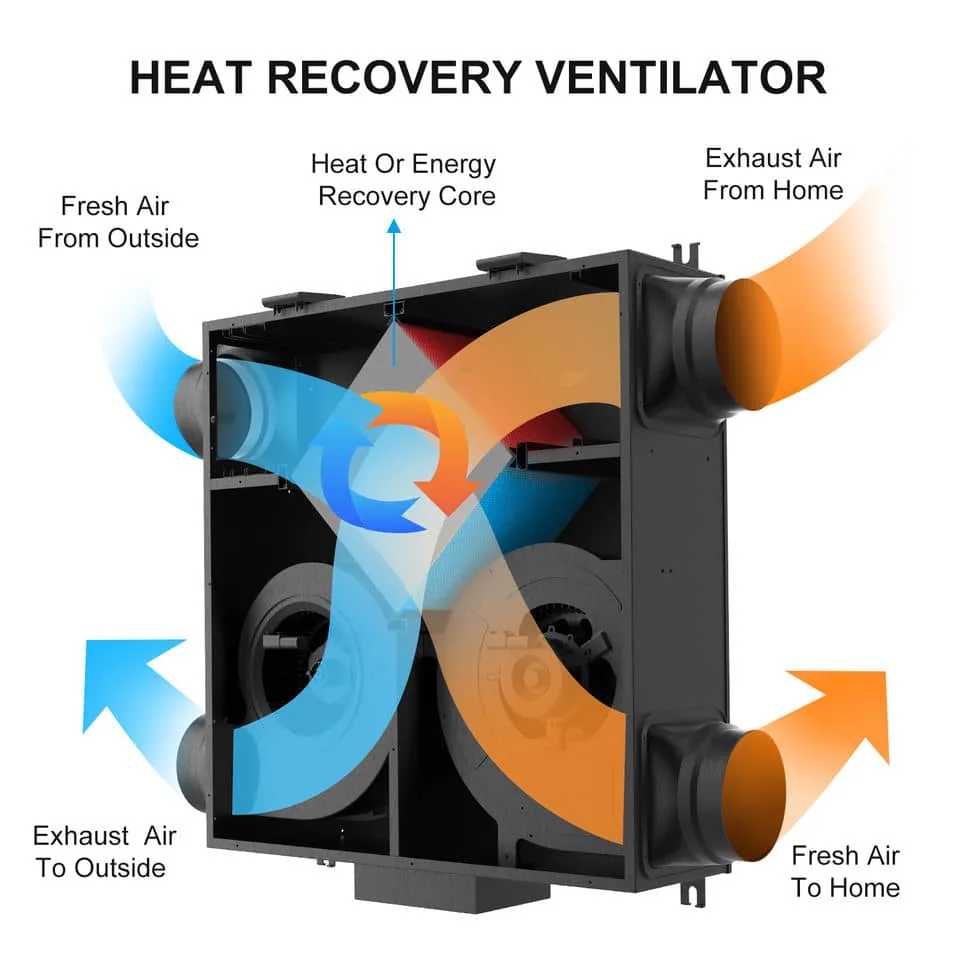
An ERV transfers heat and moisture between air streams. An HRV transfers heat without the same moisture-transfer goal. Duct fans and cabinet fans may still be part of the system when the project needs pressure support, branch airflow, or exhaust paths.
The equipment path should match the building problem. If the project mainly needs organized outdoor-air delivery with recovery, ERV or HRV review makes sense. If the system already exists but a branch run is weak or the exhaust path needs assistance, a duct fan may belong in the package instead of a full recovery unit.
This is where many product pages alone are not enough. The buyer is not always choosing a single box. They may be deciding whether the recovery unit is the center of the solution, or whether the immediate issue is moving air through a difficult duct path with better control and service access.
Filter boxes and inline fans may become part of the review when filtration, duct pressure, or branch airflow matters. Those additions should be checked against pressure impact, access side, sound expectations, and the selected model table.
| Equipment path | Best review trigger | What to confirm |
|---|---|---|
| ERV | Fresh air with humidity-transfer interest. | Climate, occupancy, airflow, filters, and drain or service needs. |
| HRV | Fresh air with heat recovery emphasis. | Climate, airflow, frost strategy, and service access. |
| Duct fan | Airflow support through a duct path. | CFM, static pressure, sound, and controls. |
For recovery-unit options, review MiWind fresh air and ERV systems. For duct support, compare the inline duct fan equipment family.
Planning boundary
For offices and classrooms, calculate early CFM needs, then check whether the project needs recovery, filtration, controls, and service access. Use that number as an initial ventilation benchmark until the design team confirms final requirements.
ACH can help with early room-volume thinking, while occupancy-based outdoor air may drive the formal design conversation. Keep both inputs visible when the project is still in distributor or procurement review.
That is the professional handoff point. The article can help the buyer or distributor organize the right questions, but the final equipment decision still depends on mechanical design, service conditions, controls, and the way the building will actually be used.
For room-volume estimates, use the ventilation CFM calculator. For recovery-equipment boundaries, read the ERV vs HRV guide.
to prepare
A useful ERV inquiry should include room use, occupancy estimate, floor area, ceiling height, operating schedule, humidity goal, filtration expectation, available ceiling or mechanical-room space, duct route, controls expectation, and whether the project is new work or a retrofit.
If duct routes, filter access, drain location, or service clearances look tight, include photos or a short note. Those details can decide whether an ERV/HRV path is practical or whether a simpler fan and filtration review should happen first.
Office ERV review should hand off to the ventilation CFM calculator, ERV/HRV selection worksheet, office application page, and current fresh-air system documents. That information helps separate a true recovery-equipment discussion from an airflow-support problem and gives the reviewer enough context to connect the calculator, worksheet, product family, and RFQ into a practical next step.
Document the recovery decision in the ERV/HRV selection worksheet. When occupancy, airflow, duct route, and photos are ready, request an office ERV review.